
Our Rice Purity Test Methodology
Written and reviewed by Adrian Vale, Editor. Reviewed . Fact-checked .
This rice purity test methodology explains how we check facts before we publish them. It covers past versions, score math, figures, wording rights, and fixes. Rice Purity Test Plus is an independent website. It is not operated by Rice University or The Rice Thresher.
What this method covers
The method starts with a narrow question. What does a source actually prove? We then separate that answer from assumptions about later versions.
A dated newspaper scan can confirm what appeared on that page. It cannot prove that each later list used the same words. A current website can show a modern list. It cannot prove a century of editing history.
Our process covers five kinds of work. We name the sources. We check dates and item counts. We record score rules. We limit claims about figures. We record wording choices.
The detailed records appear in our source register. Past stages appear in the documented history. Wording choices appear in questions and versions.
The site is independent
Rice University is an educational institution. The Rice Thresher is a student newspaper. Past tests are dated issue states. Modern quiz sites are separate web publishers. Rice Purity Test Plus is also separate.
We do not merge those entities. We do not call this site official. We do not treat a domain name, search position, or copied list as proof of endorsement.
This distinction affects each page. Past claims name the source group. Product claims describe only this project. Unknown lineage stays unknown.
Evidence Grades A through D
We grade proof by its fitness for a claim. A higher grade does not make each possible inference valid.
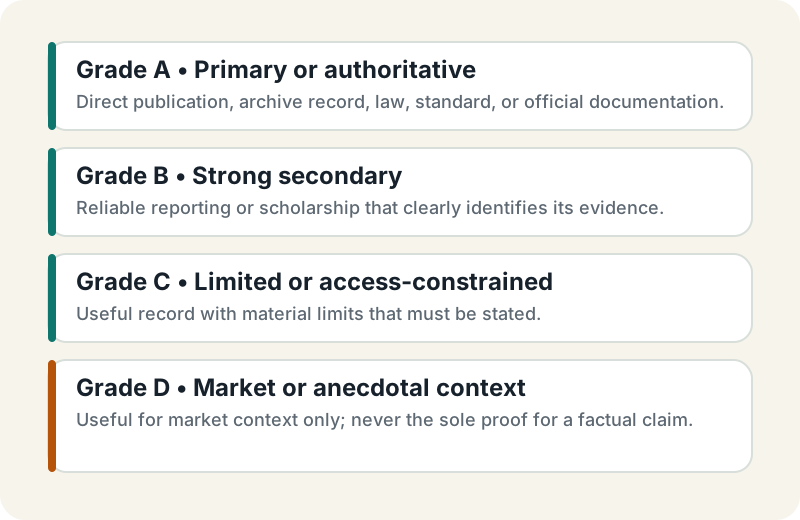
Grade A: firsthand and official records
Grade A includes firsthand scans, archive records, statutes, standards, and official policies. These sources can support direct past, legal, policy, or tech facts.
Examples include the 1988 newspaper page and the 1998 newspaper page. Each page supports facts about its own issue state.
Grade B: named institutional or scholarly context
Grade B includes accountable secondary work from named institutions or scholars. It can explain context. It does not replace a firsthand scan when the scan is available.
No claim receives Grade B merely because a page sounds authoritative. The publisher and method must be identifiable.
Grade C: transparent first-party lists
Grade C covers a site’s own list when its sample, date, and method are clear enough to evaluate. It supports only that site’s result.
The 2018 Rice Thresher figures are handled this way. They do not create a broad mean. They describe one recorded site and sample.
Grade D: market and anecdotal proof
Grade D includes rival pages, forums, and social posts. We use it for market research and user questions. It cannot serve as sole authority for past facts.
Rival links do not appear in public factual support. Rival prose is not a writing model. A repeated claim does not become verified through repetition.
How we verify archives and scans
We begin with the record title, publisher, date, and stable URL. We then inspect the page image when access allows. The visual page controls when OCR and the image disagree.
OCR is useful for discovery. It can misread numbers, punctuation, columns, or names. We therefore avoid long quotations from OCR. Any short quotation must be checked against the image.
The Rice archive finding aid confirms that 1990s purity-test material exists in Rice PRIDE records. It also records access limits. That finding aid does not reveal all restricted content.
Access problems are logged. They are not disguised as fresh checks. If a page cannot be reopened, we retain its last real check date. We also state the limitation.
How the claim ledger works
Important claims receive a stable claim ID. Each row records the claim, status, source IDs, proof grade, allowed wording, prohibited wording, check date, and notes.
The ledger helps prevent scope drift. A writer can see both what may be said and what must not be said. For example, the 1988 record supports a 150-item issue. It prohibits describing that page as the modern 100-question list.
Claims with insufficient proof are narrowed, labeled unknown, or omitted. We do not fill gaps with a plausible story. We also keep qualifications beside the claim they limit.
Score math and its limits
Dated versions used distinct totals and rules. The 1988 page says to subtract completed items from 150. The 1998 page says to count No answers across 100 questions.
The future Rice Purity Test Plus 100 will use 100 - checked items. That rule returns a count. It does not measure character, health, maturity, morality, or worth.
A numerical score can show how many listed experiences were checked under one question version. It cannot reveal why an item was checked. It cannot create a diagnosis. It cannot prove that scores from different lists are comparable.
The score method will be tested at boundary values and ordinary values. Answer processing will stay in the browser. Those product tests belong to a later phase.
Rules for publishing figures
A statistic needs a source, date, sample, population, and method. Missing context blocks broad wording.
The February 2018 Rice Thresher record reported 124,952 tests and a mean of 61.46. It also reported 2,719 scores of 100 and 336 scores of 0. Those numbers apply to that site and sample at that time.
We do not call 61.46 a broad, official, normal, or current mean. We do not invent averages by age, gender, country, school, or generation. Search demand is not proof for a demographic result.
If a later list is discussed, it must remain separate. Its data method and sample limits must be shown. Cosmetic precision does not repair a weak sample.
Question rights and version control
The repository contains no documented consent or qualified legal clearance for exact third-party wording. The review choice is therefore to author an independent Rice Purity Test Plus 100.
The United States Copyright Office explains that copyright may protect original expression. Its general guidance does not decide the status of an exact list. Our choice is a risk control, not legal advice.
Future original questions will receive stable IDs and version metadata. An ordered list will receive a deterministic checksum. Key wording or order changes will create a new version and a public change record.
We will not call the independent set official, original, unchanged, or Rice University’s version. We will not copy a for-profit rival list. Full wording is outside this phase.
Editorial review and fixes
Adrian Vale is the disclosed review pen name used by the person who researches and maintains this site. The same person currently writes and reviews each page. We state that plainly. We do not invent a second reviewer.
Review checks factual support, allowed wording, links, dates, figures, and group separation. It also checks readability, repeated text, sensitivity, and unsupported numbers.
A review date changes only after a real review. A fact-check date changes only after cited claims are checked. Neither date is generated for appearance.
Key errors should be corrected with a dated record once the public fix log exists. Silent past rewrites are not acceptable. New proof may narrow or change a finding.
What this method cannot prove
This method cannot prove an undocumented origin. It cannot turn an archive holding into consent. It cannot prove that a modern list is unchanged. It cannot guarantee legal compliance, search rankings, or advertising approval.
It also cannot remove all judgment calls. Proof can be incomplete. Archives can restrict access. OCR can fail. A publisher can update a page.
Our response is to show the boundary. Verified facts stay precise. Disputed claims stay labeled. Unknown facts remain unknown until stronger proof appears.
This approach favors a smaller defensible claim over a larger unsupported one. That is the core of our research process.