
The Documented History of the Rice Purity Test
Written and reviewed by Adrian Vale, Editor. Reviewed . Fact-checked .
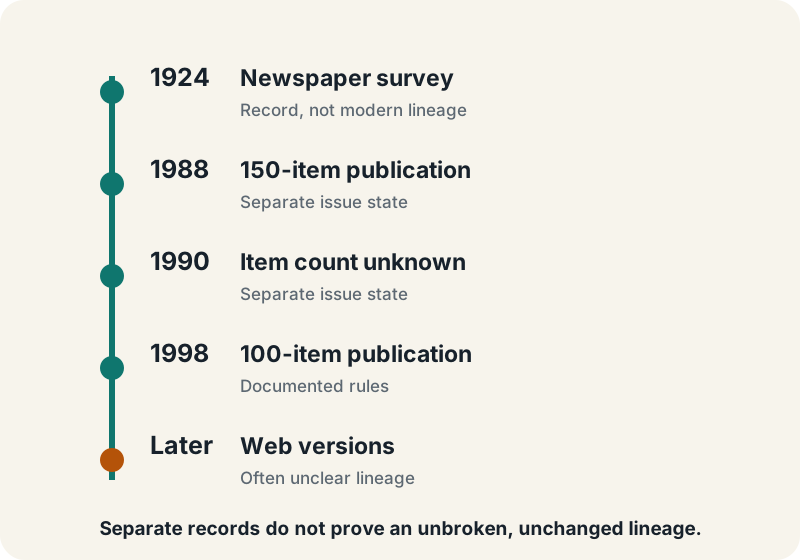
Rice purity test history has many documented stages, not one settled creation event. A 1924 survey had ten questions. A 1988 issue had 150 items. A separate version appeared in 1990. A 1998 page documented 100 questions. Today’s common web wording has no proven continuous lineage across those records.
The short documented timeline
| Date | Source state | Verified count | Recorded scoring | Main limit |
|---|---|---|---|---|
| 1924 | Newspaper survey | 10 | Published survey result | Not the modern list |
| 1988 | Rice Thresher issue | 150 | 150 minus completed items | Not a 100-item version |
| 1990 | Separate newspaper issue | Unknown after current access limit | Unknown after current access limit | Must not be merged with another year |
| 1998 | Rice Thresher issue | 100 | Count No answers | Does not prove modern lineage or reuse rights |
| 2018 | Web aggregate record | Not a question-version claim | Reported sample figures | Not a broad mean |
| Web era | Multiple implementations | Often 100 | Often 100 minus checked items | Exact lineage remains unresolved |
This table shows why a single origin date can mislead. Different sources document different objects. The source register records the proof behind each row.
1924: an early survey, not today’s test
The earliest approved record is a March 7, 1924 issue of The Rice Thresher. Rice University Digital Collections preserves the newspaper issue.
The issue reported an informal ten-question survey of 119 women undergraduates. It used the headline Rice Girls Not Quite Half Bad. That record is important, but its meaning is narrow.
It shows an early campus survey about conduct. It does not show the modern 100-question list. It does not prove that today’s wording was written in 1924. It also does not prove an unbroken editing chain from that page to current websites.
The source date is the date of the issue. It is not automatic proof that the broader tradition began that day. Earlier related activity would need its own proof.
The survey also reflects its period. It focused on women students. Modern descriptions should not erase that context or convert it into a timeless assessment.
The page could not be reopened during our August 28 review. Its last recorded check remains August 23, 2026. We therefore avoid fresh quotations until the page image can be checked again.
Why the 1924 record is often overstated
A simple origin story is easy to repeat. It is also less accurate. The ten-question survey and the modern list differ in scale, wording, context, and likely editing history.
Calling the 1924 survey the modern test collapses those differences. Calling it a Rice University product also blurs the institution and its student newspaper.
The precise statement is smaller. The Rice Thresher published an early documented survey in 1924. That survey belongs in the history. It does not settle the origin of today’s web wording.
This distinction also affects the word “original.” The original-version guide explains why that label needs a date and source.
1988: a documented 150-item issue
The next central record is the April 1, 1988 newspaper page. The page presents the New and Improved 1988 Rice Thresher Purity Test.
The documented page contains 150 numbered items. Its rules give one point for each completed item. The reader then subtracts that total from 150.
That rule matters. It confirms both the total and the scoring base. A person with no completed items would remain at the top of the 150-point scale. The math differs from a 100-item scale.
The record directly contradicts claims that the documented 1988 issue had 100 questions. It also warns against using “the 1988 version” as a loose name for a later list.
The page is a firsthand scan with an OCR transcript. OCR can confuse columns, punctuation, and characters. Our factual use stays with the shown count, title, date, and stated rule. We do not reproduce the items.
What the 1988 page does not prove
The page documents one issue state. It does not prove rights for a later for-profit copy. It does not prove that a current list descended word for word from its items.
It also does not make a modern domain official. A past connection must be shown with records, not inferred from similar math or branding.
The term “improved” appears in the past presentation. It describes that page’s framing. It is not proof that the test became scientific, valid, or endorsed.
The 1988 source is therefore strong proof for a 150-item version. It is weak proof for claims about an unrelated current site’s ownership.
1990: a separate issue state
A Rice Thresher issue dated April 1, 1990 contains another long purity-test issue. Rice University Digital Collections preserves the 1990 issue.
The current register treats 1990 as its own state. We do not assign it the 1988 total. We do not assign it the 1998 rule. We also do not invent an exact item count.
The source was access-restricted during the August 28 review. Its recorded check date remains August 23. A fresh page-image review is required before detailed claims.
This limitation is useful. It prevents an uncertain middle version from becoming a convenient bridge between better documented pages.
Unknown count does not mean no record exists. It means our current proof does not support a precise public number. The correct response is to preserve that boundary.
1998: a documented 100-question version
The November 13, 1998 issue provides a different clear state. The digitized page identifies The 100-Question Rice Purity Test.
The count is explicit. The rules say to add the number of No answers. This produces a score from the answers to that 100-question page.
The same source defines MPS as “Member of the Preferred Sex.” That past definition belongs to this documented context. It should not be imposed on each version or used as proof of modern wording.
The 1998 page is important because it shows a documented 100-question state. It does not erase the 150-item 1988 page. Both can be authentic past issues from different dates.
This is the core version lesson. A tradition can change. A later 100-question page does not make the earlier page 100 questions in hindsight.
What the 1998 record cannot grant
A newspaper scan can show what was printed. It does not automatically grant for-profit reproduction consent. It also does not settle who owns each later arrangement.
The source does not identify a current ranking domain as an authorized successor. It does not prove that common web wording is identical to its text.
For these reasons, Rice Purity Test Plus will not publish the past list as its list. The future project will use independently authored wording. The questions and versions guide explains that control.
The Rice archive adds another layer
The Woodson Research Center lists a file titled Purity Test, 1990s within Rice PRIDE records. The finding aid confirms that related material exists.
Some archive material is restricted because it contains sensitive facts. The finding aid states that restricted folders remain restricted until 2062. It also asks users to follow copyright law when they reuse material.
An archive holding is proof of preservation. It is not public consent. It may not expose enough content to resolve wording lineage.
The finding aid therefore supports a broader campus and archival history. It does not fill each gap between the newspaper versions and today’s websites.
A course record shows critical context
Rice University’s 2016-2017 course catalog lists the test among issues in FWIS 145, Sexual Ethics.
That record shows the test can be studied as a cultural and ethical artifact. It does not validate the quiz as an assessment.
This distinction matters because popular descriptions often assign more meaning to a score than the math allows. Academic discussion is not scientific validation.
2018: a large recorded sample with limits
In February 2018, The Rice Thresher’s State of the Pure page reported results from 124,952 tests. It recorded a mean of 61.46. It also recorded 2,719 scores of 100 and 336 scores of 0.
These are precise past figures. Their scope is equally precise. They describe that site and sample at that date.
The data does not prove a broad mean. It does not define a normal score for all ages, countries, schools, or groups. People who chose to take that site were not a random population sample.
The page returned an access error during our August 28 review. We retain its August 23 check status. We do not pretend the page was freshly available.
Why the 2018 mean is not a timeless benchmark
A mean changes with the question set, audience, period, and collection method. A self-selected web sample can differ from a classroom, campus, or national sample.
Even a large count does not remove selection bias. Precision after the decimal point does not create representativeness.
The reported mean is useful past context. It is not a moral dividing line. It should never be used to label a person good, bad, pure, or impure.
The modern web era
Modern websites commonly show 100 scored items. They often calculate 100 minus checked items. Yet their wording, numbering, labels, and extra text can differ.
No approved source in this repository proves one continuous editing chain from 1924 through each later issue to the common web list. The exact modern lineage remains unknown.
Similarity is not enough. Shared topics can result from copying, adaptation, older circulation, or independent revision. A defensible history needs dated proof between states.
Modern popularity also does not create official status. Search rank, an exact-match domain, and repeated claims are not institutional proof.
Rice University and The Rice Thresher are different entities
Rice University is the institution. The Rice Thresher is its student newspaper. A student-newspaper issue should be credited to that issue unless proof shows a different author or sponsor.
Saying “Rice University created the modern test” is broader than the approved records support. It hides the role of dated newspaper pages and later editors.
This site is separate from both entities. Its name describes the subject and the added focus on privacy, proof, and context. It does not signal endorsement.
Verified, disputed, and unknown
Verified
The 1924 issue reported a ten-question survey. The 1988 page had 150 items and a 150-based rule. The 1998 page documented 100 questions and counted No answers.
The archive finding aid exists. The course record exists. The 2018 figures are recorded with a sample-specific limitation.
Disputed or unsupported
The claim that the documented 1988 test had 100 questions conflicts with the firsthand page. Claims of an unchanged list across all years lack a demonstrated chain.
Claims that a reviewed for-profit site is official also lack approved institutional proof.
Unknown
The exact count and scoring details of the 1990 page await a fresh image review. The exact editing history of today’s web wording is unresolved.
Authorship and rights facts for each item are also incomplete. Those gaps prevent a confident verbatim-reuse claim.
Why one date cannot answer each origin question
“When was the test created?” can mean many things. It may ask about the earliest survey, a named test, a 100-question issue, or today’s web wording.
The answer changes with the object. The 1924 date belongs to the early survey. The 1988 date belongs to a 150-item issue. The 1998 date belongs to a documented 100-question page.
No one date proves the origin of all later language. Good history keeps the noun attached to the date.
That is why our timeline uses version states. It is more accurate than a single smooth story. It also leaves room for new proof without rewriting the past.
How new proof would change this timeline
A new source would not automatically replace the timeline. We would first record its title, publisher, date, URL or archive location, and access conditions in the source register. We would then compare its item count, scoring method, audience, terminology, and issue context with the documented states already listed here.
The strongest addition would be a dated firsthand record with a clear source history. An archive scan, a newspaper issue, or a course record from that time can prove what then existed. A later recollection may still be useful, but it cannot carry the same weight for exact wording or dates.
Conflicts would remain clear. If two credible records describe different lists in the same year, the result would be two documented states, not a forced composite. If a new record closes one gap but leaves another open, only the supported claim would change.
Each key revision would update the page date and its cited source IDs. The related questions and versions guide would also be checked for consistency. This process lets the history improve without turning uncertainty into certainty.
Archive access can also change. A page that is available today may later move, require an institutional login, or disappear from a public index. Our source record therefore separates the existence of a citation from our present ability to inspect each page. We do not describe inaccessible text from memory.
When access is limited, the public claim must stay within what the repository proof supports. A catalog record may confirm a title and date without confirming a full list. A search result may help locate a record, but it is not a substitute for the underlying issue. Secondary discussion can point toward firsthand proof, yet it cannot silently become that proof.
This approach also protects against false precision. A scan can prove an issue date while leaving authorship unclear. A course page can show that a topic was taught without proving the origin of each quiz item. Each record answers a bounded question.
Future updates will preserve earlier source notes so readers can see why a finding changed. If a fix affects dates, counts, or attribution, we will describe the old statement, the new statement, and the proof behind the fix. That creates an audit trail instead of an invisible rewrite.
For the source details, use the source register. For the meaning of “original” and “official,” use the original Rice Purity Test guide.